

When an Antminer Hydro miner stops working properly, with a low or 0 hashrate, it may be due to faults in network connectivity, hardware components, power supply, or environmental conditions. By carefully observing the miner's indicator lights, the operational status, and messages in the kernel logs, operators can quickly diagnose and repair the problem.
This guide outlines four main troubleshooting methods for Antminer Hydro miners, helping to improve repair efficiency and ensure the miner's normal operation.
Method 1: Visual Inspection of Indicator Lights
The first and fastest diagnostic step is to observe the miner's Indicator Lights—specifically the Ethernet port light, the red fault light, and the green normal indicator light.
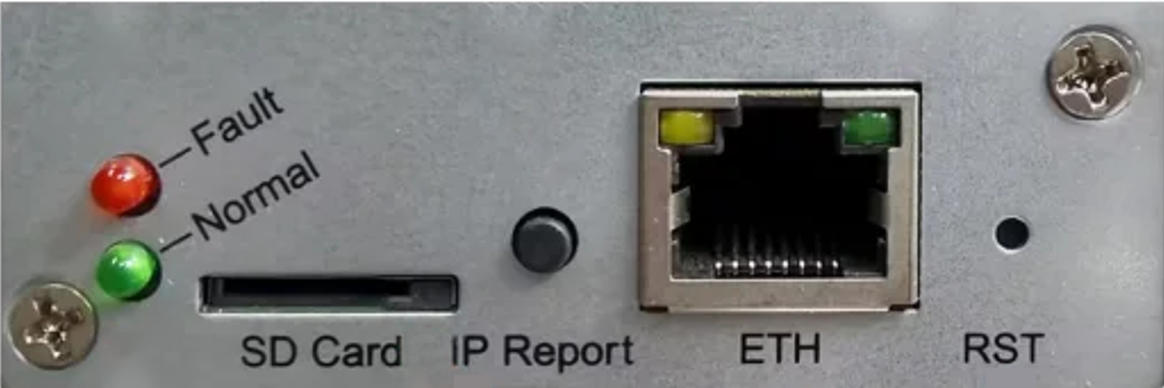
The table below summarizes the common light combinations and their associated faults:
| ETH port (Yellow light) | Long light | Extinguish |
| ETH port (Green light) | Flash | Extinguish |
| Working conditions | Normal | Fault 1 |
| Fault light (Red) | Extinguish | Flash | Extinguish | Long light |
| Normal light (Green) | Extinguish | Extinguish | Long light | Extinguish |
| Working conditions | Normal | Fault 2 | Fault 3 | Fault 4 |
Fault breakdown and solutions:
Fault 1
1. The network cable may not be plugged in properly or damaged: Reconnect or replace the network cable.
2. The switch is not powered on or damaged: Turn on the switch or replace it.
Fault 2
High temperature fault: Power on the miner and check if the interface valve is open and if the water temperature is normal.
Fault 3
The system has crashed and cannot obtain an IP: Restart and reset. If the issue persists, the control board is likely faulty
Fault 4
1. Incorrect IP or IP conflict: Change the IP.
2. Network setting error: Change or reset the IP address in the background.
3. All the information of the three mining pools is wrong: Check the mining pool configuration.
Method 2: Observe the ETH port, indicator lights, and Antminer operating status
Determine Hydro failure by observing the ETH port, indicator light, PSU and Antminer status.
Hydro's operation status | Failure causes | Solutions |
ETH port light Normal light extinguishes Fault light extinguish | Unable to obtain IP | The control board is faulty; replace it. |
No backend data | Try Restart, Reset, Flash firmware, and Restart in sequence. If it still fails to boot, the control board is faulty and needs to be replaced. | |
ANTMINER can't operate | Unstable PSU or voltage | Unplug and replug the power cord; replace the PSU if it fails again |
Control board power cord is loose | Securely plug in the control board power cord | |
Miner not powered on | Replace the control board | |
PSU is too cold | Move the PSU to a warm environment to preheat | |
PSU and ANTMINER can't operate | PSU failure | |
PSU overheating | Let the PSU cool down, then restart | |
The PSU copper row screws are loose. | Tighten them | |
ANTMINER is at a low hashrate | The hashboard chip is damaged | Check if the hash board power cord is tight and restart |
PSU has insufficient power consumption | Replace the PSU and restart | |
Hashboard hardware with a high error rate | Restart; if the issue persists, the hashboard is damaged | |
Missing hashboards | Restart; if the issue persists, the hashboard is damaged | |
Cable damage | Replace the cable |

Method 3: Using the Backend Dashboard
External inspections may not always reveal the root cause. For a more detailed diagnosis, log in to the miner's backend interface.
1. 0 Hashrate on a Board: The dashboard will show that a hashboard (e.g., Board 2) is producing 0 hashrate.

2. Abnormal Temperature: The dashboard will indicate if a hashboard (e.g., Board 3) is experiencing abnormally high temperatures.

Method 4: Analyzing the Kernel Log for Deeper Diagnostics
If the miner's backend shows no data or the fault cannot be identified visually, the Kernel Log is the final diagnostic tool. Access it by navigating to the "Kernel Log" section in the miner's backend interface.

Common log failures and their solutions include:
Fault 1: Unable to connect to the Internet.
Solution: Check the network cable, replace it if damaged, and verify the switch and network status.

Fault 2: Server temperature is too high
Solution: Check if the interface valve is open and if the water temperature is normal.

Fault 3: Power supply failure
Solution: Re-plug PSU cables, upgrade firmware, replace the PSU, or tighten copper row screws.

Fault 4: hash board find 0 ASIC
Solution: Restart, power off, and check for loose cables. If abnormal, repair.

Fault 5: Cannot find the hash board
Solution: Restart, check cables and screws, restore factory settings, upgrade firmware, or repair.

Fault 6: Chip test abnormal
Solution: Restart or flash firmware via SD card. If abnormal, repair.

Fault 7: Missing chips
Solution: Restart or flash firmware via SD card. If abnormal, repair.

Fault 8: Voltage error, initialization failed
Solution: Restart, re-plug cables, flash the firmware, and reconfigure the mining pool.

For routine maintenance, please use deionized water or antifreeze for internal circulation—never use tap water. If the water pipes turn yellow due to substandard water quality, immediately disconnect the power, clean the system, and replace the coolant. In cold environments, ensure the water temperature is above 20°C when the miner starts; otherwise, the low-temperature protection mechanism will be triggered.
If the above steps do not resolve the issue, it is recommended to contact Zeus Mining technical support. They can provide further diagnostics. However, in most cases, checking indicator lights, the backend, and kernel logs will provide the correct solution.
 China Mainland Hong Kong
 Business Hours: (GMT+8) 08:30-20:00 Mon to Sat
 Company Phone: +86-023-72227777