

The Bitaxe SupraHex 701 4.2TH/s is a Solo lottery miner designed for Bitcoin mining, combining low power consumption, quiet operation, open-source design, and easy setup. It integrates 6 BM1368 ASIC chips, uses the SHA-256 hashing algorithm, and is optimized for high hash rate, low latency, and stability, making it ideal for home and small-scale mining. We analyze its parameters in depth through a real review video of the SupraHex 701 miner.
I. Unboxing and host appearance Introduction
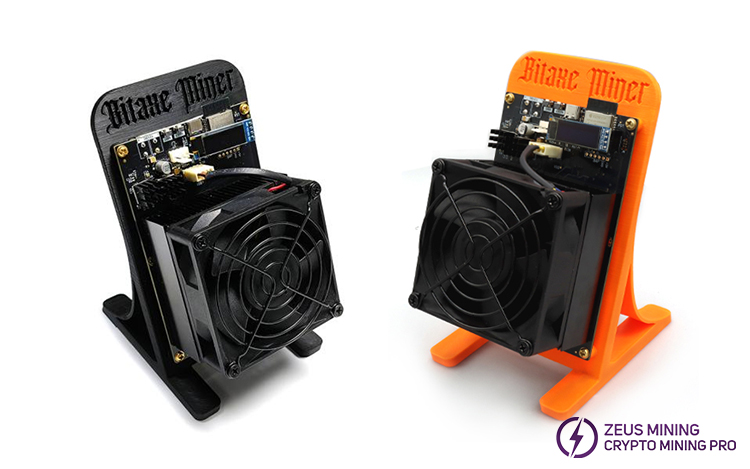
1. The package includes the Bitaxe SupraHex 701 mining host, a 12V power adapter, and a power cable.
2. The host is available in two colors: Classic Black (used in our review) and eye-catching Orange.
3. It has a compact and portable design, measuring 9.5cm x 16cm x 11.5cm, which occupies minimal space.
4. Features a real-time monitoring LED screen and an 80mm high-speed dual-ball bearing fan.
II. Use experience and data analysis
For the Bitaxe SupraHex 701 Solo miner review, please click here to watch the video.
1. Independent and User-Friendly Experience, supports connection to 2.4G Wi-Fi network segment. Connect the 12V power supply, link the device to the network, and direct it to our Bitcoin node or independent mining server. The all-in-one design makes it easy to solo mine without a complex technical setup.
2. Bitaxe SupraHex 701 operational Parameters and analysis
Evaluation data of 5 different frequency core voltages (average value) | |||||
Frequency (MHz) | 500 (Overclocking) | 525 (Overclocking) | 550 (Overclocking) | 575 (Overclocking) | 490 (Default) |
Core Voltage (mV) | 1200 | 1250 | 1250 | 1300 | 1166 (Default) |
Fan speed | 100% | 100% | 100% | 100% | 80% |
Uptime (H) | 1 | 1 | 1 | 1 | 17 |
Hashrate ±10% | 3.9TH/S | 4.1TH/S | 4.3TH/S | 4.5TH/S | 3.8TH/S |
Power ±10% | 94W | 113W | 120W | 148W | 87W |
Noise ±10% | 55dB | 54dB | 56dB | 55dB | 53dB |
Temp ±10% | 45°C | 45°C | 46°C | 55°C | 40°C |
Data analysis
• Hash rate & power consumption are positively correlated with frequency/core voltage settings.
When the frequency/core voltage is set to the maximum 575MHz/1300mV, with an average power consumption of 148 W.
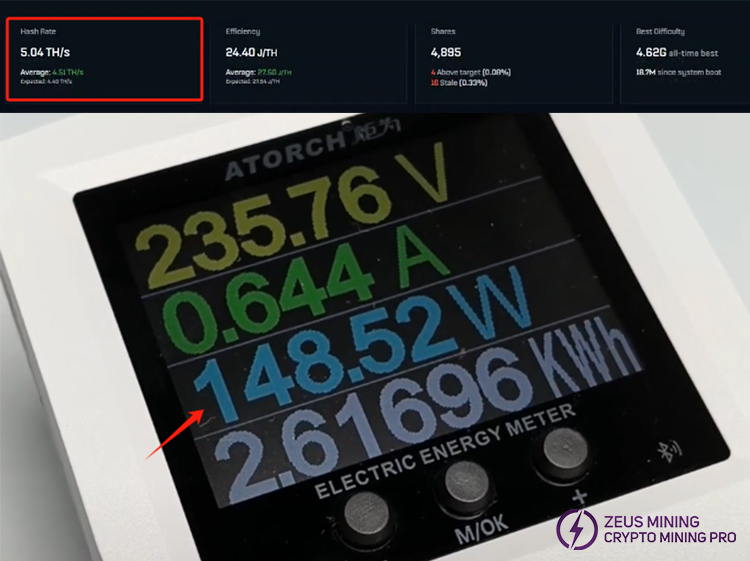
In the 490MHz/1166mV default settings, the average hash rate is 3.8TH/S and the power consumption is only 87W.
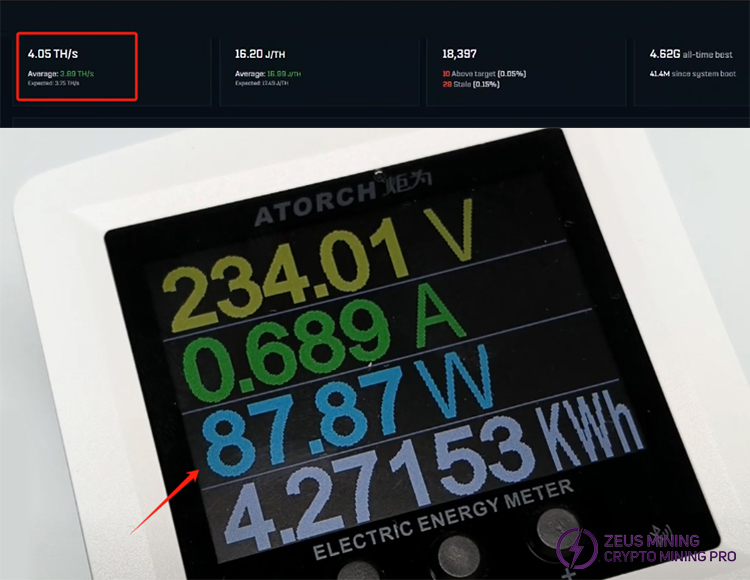
• In the 17-hour continuous mining test, the average hash rate showed high stability with minimal fluctuations. Actual power consumption outperforms most similar miners. Running at 87W for 24 hours consumes approximately 2 kWh of energy. If running at 87W for 24 hours, it consumes approximately 2 kWh of energy. Suppose the local electricity price is $0.1/kWh. 2 * $0.1 = 0.2 Dollar. This is equivalent to running a whole day at a very low electricity cost under the above conditions. The single machine operation cost is low and suitable for continuous mining.
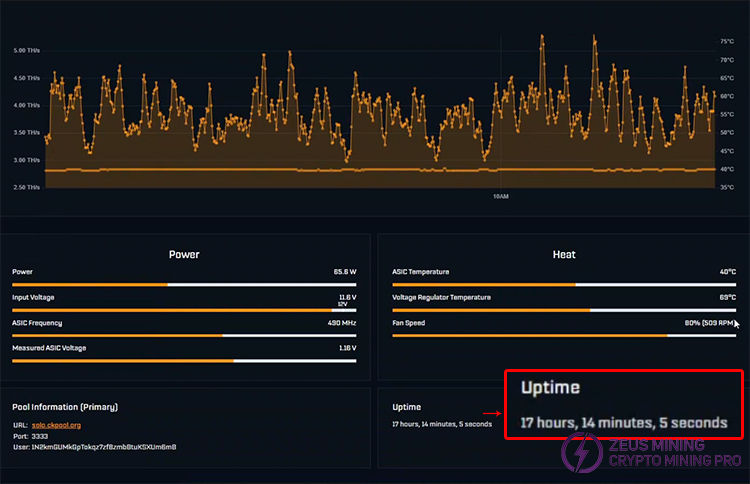
• When the frequency and core voltage are set to the default 490MHz and 1166mV, the performance and power consumption are most balanced and the energy efficiency is optimal.
• Heat dissipation stability
Excellent temperature control—even at high frequencies (575MHz) —the temperature remains at 55°C ± 10%.
During a 17-hour long-term operation, the temperature stabilizes at 40°C, the fan speed drops to 80%, and the noise level is only 53dB.
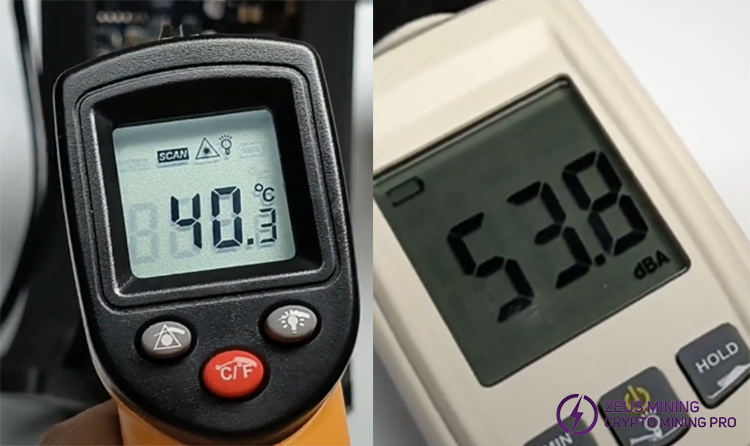
• For under 5 frequency and core voltage settings, the noise level ranges from 53dB to 56dB ±10 % tolerance. It is relatively stable, with the noise increasing at high frequencies and decreasing at low frequencies.The sound is so quiet that it's about the same as the background volume in an average library or quiet office.
Conclusion:
If there is a high requirement for the hash rate, you can choose to mine in the high-frequency mode, which can help you get the desired results more quickly. For scenarios where there is a high demand for quiet operation and the device is expected to run for an extended period, the low-frequency mode can be prioritized. Moreover, in this mode, the temperature and noise levels are at their lowest, making it suitable for home or office environments. It not only takes efficiency into account but also extends the device's lifespan. The SupraHex 701 offers top-level efficiency due to its compact size, minimizing energy waste to the greatest extent possible. Its noise level is equivalent to that of a library, making it highly suitable for both home and office environments.
III. Unique advantages
1. AxeOS firmware can flexibly switch between independent and pool mining modes
• Independent mining: Chance to earn full block rewards (similar to a lottery). High rewards are available if a block is found; low-cost participation in the Bitcoin network is also possible if not.
• Pool mining: Steady, predictable earnings.
• Users can configure pool URLs and credentials for pool mining or point to a local Bitcoin node or independent server for solo mining, offering flexibility to align with their personal goals.
2. Low-latency architecture
• Optimized firmware reduces hash rate submission latency, which increases the probability of block discovery.
• Built-in Bitcoin Node support allows us to run a local Bitcoin Core node, enhancing mining decentralization.
3. Open-source transparent design
• Fully open-source hardware and firmware (AxeOS), aligning with Bitcoin’s decentralized ethos. Users can audit the miner’s code, ensuring no hidden fees or backdoors.
4. "Lottery" mining potential, the SupraHex 701 4.2TH/s offers individual users the opportunity to earn full Bitcoin block rewards—a unique benefit of solo mining, similar to a lottery.
Recommendation index: ★★★★★
The Bitaxe SupraHex 701 4.2TH/s, designed for solo mining with a compact, fully open-source hardware and software design, is an ideal choice for SOLO miners. Beyond professional home and small-scale mining setups, it allows beginner miners to participate in network security maintenance while potentially earning full rewards. The SupraHex 701 Bitcoin miner offers a robust, user-friendly design for decentralized, self-reliant mining participation.
 China Mainland Hong Kong
  Business Hours: (GMT+8) 08:30-20:00 Mon to Sat
  Company Phone: +86-023-72227777