

For newcomers to cryptocurrency, "Bitcoin or Ethereum" is a classic question. This article provides a clear and detailed comparison guide from four dimensions: fundamental understanding, purchase and storage, transaction costs, and use cases.
Bitcoin and Ethereum are not just two different crypto assets; they represent two completely different investment logics and technological positioning.
Bitcoin (BTC): "Digital Gold" as a Store of Value
Bitcoin is the world's first cryptocurrency, created by an individual or team using the pseudonym "Satoshi Nakamoto." Its core vision is to build a peer-to-peer electronic cash system and become a decentralized store of value. Bitcoin is widely accepted in the market, primarily due to its scarcity resulting from its fixed total supply (21 million coins) and its asset attributes as a hedge against inflationary risks in the traditional financial system. Therefore, Bitcoin focuses more on its "currency" function, making it a strategically allocated asset.
Ethereum (ETH): An "Application Platform" for the Decentralized World
Ethereum is a global, open-source decentralized software platform. Its native currency is called Ether or Ethereum (ETH). Buying ETH is not only about the expectation of asset appreciation but also about participating in its ecosystem. Based on Ethereum, users can conduct decentralized finance (DeFi) activities, mint or trade NFTs (non-fungible tokens), and experience blockchain games. Therefore, Ethereum focuses more on its "utility" attribute, and its value is closely related to the activity level of its ecosystem.
Differences between Bitcoin and Ethereum
Differences | BTC | ETH |
Date of creation | 2009 | 2015 |
Status | The founder of the first blockchain | The founder of second-generation blockchain |
Issuance mechanism | Proof-of-Work (PoW) consensus mechanism | Proof-of-Stake (PoS) consensus mechanism |
Block production time | Approximately 10 minutes | Every 10 to 20 seconds |
Transaction speed | Processing approximately 7 transactions per second | Processes approximately 30 transactions per second |
Total supply | Maximum capacity: 21 million | No upper limit, but introduces a deflationary mechanism |
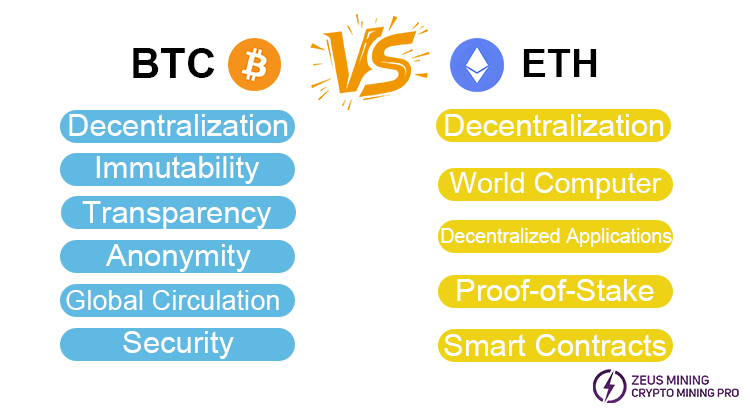
Application Scenarios Differences
Bitcoin's core design aims to build a decentralized monetary system with a fixed total supply and resistance to inflation. Based on this technological premise, Bitcoin's most mature application in practice is as a store of value, widely regarded as "digital gold," primarily used for asset allocation and value preservation.
In contrast, Ethereum's core innovation lies in the introduction of smart contract functionality, making it a programmable blockchain platform. Developers can build and run various decentralized applications (DApps) on Ethereum, thus giving Ether a richer and more diverse range of applications, mainly in the following areas:
1. Decentralized Finance (DeFi): Financial products built through smart contracts that do not require intermediaries from traditional financial institutions, including lending protocols, decentralized exchanges, stablecoin mechanisms, and insurance services.
2. Digital Assets (NFTs): Non-fungible tokens (NFTs) are indivisible and non-fungible digital asset certificates that can represent ownership of unique items such as digital artwork, game items, and virtual land.
3. Governance and Voting: Ethereum's governance mechanisms support the operation of decentralized autonomous organizations (DAOs), enabling community-driven on-chain voting, proposal management, and fund allocation.
End-to-end convenience comparison
Comparison of convenience across the entire purchasing process
Link | User core considerations | Objective situation of BTC | ETH objective situation |
Purchase portal | Payment method support and operation process | It is supported by almost all exchanges, with no difference in accessibility | It is supported by almost all exchanges, with no difference in accessibility. |
Storage security | Asset custody security, self-custody options | Stored in a BTC address (starting with 1, bc1q). The individual holding the private key is responsible for its security. | Stored in an ETH address (starting with 0x). Participating in DeFi and similar operations is more complex and carries higher risks. |
Transfer efficiency | Speed of payment arrival and transparency of fees | Network fees (miner fees): Determined by competition for block space. High costs and slow confirmation times (10 minutes to several hours) occur during periods of congestion. | Gas fees are determined by computational complexity and network congestion. They are highly volatile, with confirmation times as low as tens of seconds. |
User experience | Learning cost, functional integration | Low cost. The core functions are holding and transferring funds; the concept is simple. | High. To participate in its ecosystem (DeFi, NFTs, etc.), one needs to understand complex concepts such as smart contracts, gas limits, and authorization. |
Conclusion
Choosing between Bitcoin and Ethereum is not a simple either-or choice, but a strategic question about asset allocation priorities.
If you prioritize simplicity and certainty, and agree with Bitcoin's value-store logic as "digital gold," then making Bitcoin a core holding is a prudent choice. If you are curious about the technological evolution of blockchain and willing to explore the forefront of decentralized finance and its ecosystem applications, then Ethereum may be better suited to your investment expectations.
However, for most newcomers, instead of agonizing over this choice, a more balanced strategy is better: include both in your portfolio. This not only diversifies the technological and market risks of a single asset but also allows you to simultaneously enjoy the certainty of "value storage" and the potential for "ecosystem growth"—undoubtedly a more relaxed and intelligent starting point for investors new to digital assets.
Disclaimer:
For cryptocurrency tutorial purposes only, not investment advice. This website is not responsible for the actions taken by readers based on the information in this article.
For more products and information, please click to join our official Telegram channel.
 China Mainland Hong Kong
  Business Hours: (GMT+8) 08:30-20:00 Mon to Sat
  Company Phone: +86-023-72227777