

The cryptocurrency mining pool reward mechanism is the core link between miners and mining pools. Each mining pool has its own unique reward distribution scheme. Understanding the working principles of these mechanisms is crucial for miners to select the mining pool that best suits their needs. This article will provide a thorough analysis of mainstream mining pool reward mechanisms, including PPS, PPLNS, FPPS, PROP, and SOLO, to help miners choose the mining strategy that best suits their needs.
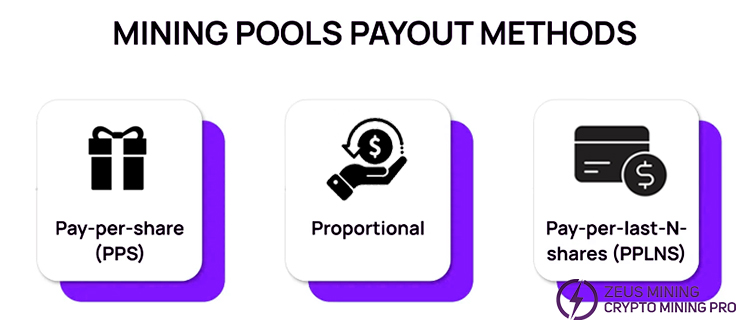
PPS is one of the most popular reward mechanisms for miners because it provides a stable and immediate income. This reward mechanism is that miners will receive a fixed reward for each share submitted to the mining pool. Miners will receive rewards regardless of whether the mining pool successfully mines a block. And the mining pool that adopts PPS rewards bears all the risks, so the handling fees charged will also be higher.
Advantages: Provide stable and reliable income. Protect miners from unpredictable risks. Predictable expenses make it easier to manage operating costs.
Disadvantages: Compared with other payment methods, PPS has higher handling fees. Potential long-term income is lower. Miners can easily switch mining pools without incurring financial penalties, which may increase the churn rate.
The income is distributed according to the number of shares contributed by the miner. Unlike PROP, PPLNS rewards loyal miners to prevent pool hopping and extend the period during which the number of shares submitted by miners remains constant in the past few blocks. Not only is the contribution of the current block considered, but also the shares of the past few blocks are traced back. This mechanism avoids frequent pool hopping by miners and encourages long-term mining.
Advantages: Prevent "pool hopping" and improve the stability of the mining pool. In the long run, the income is similar to PROP but more stable.
Disadvantages: New miners have a low initial income and must wait for some time to reach normal levels.
PPS+ is a fusion of the above two modes, PPS and PPLNS. Block rewards are settled according to the PPS mode, while mining service fees and transaction fees are settled according to the PPLNS mode. This means that miners are exempt from paying part of the transaction fees.
Advantages: PPS+ combines the stability of PPS and the flexibility of PPLNS, allowing miners to share additional benefits when the fees are high. This hybrid model mitigates the payment risk associated with the mining pool.
Disadvantages: Short-term benefits may fluctuate, particularly during low-fee periods or when the mining pool produces blocks at a slow rate. Miners need to mine for a long time to maximize the benefits of the PPLNS part, which is not suitable for short-term mining strategies that frequently switch mining pools.
FPPS is paid in full according to shares. Its core principle is to use the PPS mode for instant settlement of both block basic rewards and transaction fees. In this mode, block rewards and mining fees are settled according to theoretical benefits. Calculate the standard transaction fee for a specific period and distribute it to miners based on their hash rate contribution to the mining pool. Increase miners' income by sharing part of the transaction fee.
Advantages: Block rewards and transaction fees are settled instantly at a fixed rate, providing miners with the most stable income guarantee. This mechanism is particularly suitable for periods of high network fees.
Disadvantages: Since the mining pool bears all payment risks, it typically charges high fees, which can significantly reduce miners' net income during periods of low fees. Miners cannot obtain additional bonuses through long-term mining.
The PROP method rewards miners in proportion to the number of valid shares they contribute to the pool and the contribution they make to finding the block. If a miner contributes 20% of the share of finding the block, and the block reward is 200 coins, then the miner will receive 40 coins.
Advantages: Fairness - income is linked to personal contribution; the more we pay, the higher the reward. Miners' income is relatively predictable.
Disadvantages: Miners do not always find blocks at precisely defined time intervals. The frequency of finding blocks by the pool may be higher or lower than the average. The PROP system is easily affected by luck.
The pool reward model of SOLO mining is that we can only get the full reward when we mine the block independently, and a small service fee will be deducted. Miners receive both block rewards and transaction fees.
Advantages: The SOLO model enables miners to receive 100% of the block reward directly, without sharing the income with other miners.
Disadvantages: This model is entirely dependent on personal hash rate and luck, and small miners may face the risk of not being able to produce blocks for weeks or even months.
DPPLNS | Similar to PPLNS, the number of shares within the calculation cycle is dynamically adjusted on this basis to balance the income and alleviate the problem of low income in the early stages. |
PSOLO2 | A predictable SOLO variant occurs when the hash rate contributed by the miner reaches the current network difficulty, allowing the reward to be obtained and reducing uncertainty. |
PPLNT | Calculate the share according to the last N time frames, rather than blocks, such as a fixed half-hour interval. |
DGM | The core feature of the hybrid geometry method and PPLNS is the use of a dual geometric algorithm to adjust the share value dynamically. The pool buffers part of the reward in the short term and releases the buffer funds in the long term. Ensure the stability of miners' income. |
PPLTS | Reward loyal miners with a combination of PROP and PPLNS, and penalize short-term hash rate fluctuations. |
PARTY | In the privatized, customized PROP model, income is strictly distributed according to the proportion of hash rate contributed in the past 24 hours. The hash rate statistics are immediately cleared after each block is produced, starting a new cycle. |
PPTS | Calculate the income every 30 seconds and distribute it according to the miner's real-time hash rate. A total of 20 times (i.e., 10 minutes) is a complete settlement cycle. |
There is no absolute good or bad way to distribute mining pool rewards. The key is to match the needs of miners. We need to make choices based on our hash rate, risk tolerance, and planning to maximize mining benefits!
> > More information
FAQ
Q: How do miners receive their rewards?
A: Miners are compensated for their labor in two ways: block rewards and transaction fees. Block rewards refer to a certain amount of cryptocurrency reward for mining a block. As the issuance of new currencies, such as Bitcoin, slows down, transaction fees become a more important source of income for miners.
Q: How do bigger mining pools benefit everyone?
A: Large mining pools generally have a higher probability of cracking a block due to their combined hash rate. Large mining pools may have smaller payouts because they are spread across more participants. It is also essential to consider the frequency of payouts of the mining pool; some mining pools pay daily, while others pay weekly or monthly.
Disclaimer:
This article is for informational purposes only; please refer to other official sources for more details. This website is not responsible for any losses caused by any actions taken by readers based on this article and reserves the right to final interpretation.
 China Mainland Hong Kong
  Business Hours: (GMT+8) 08:30-20:00 Mon to Sat
  Company Phone: +86-023-72227777