

Cryptocurrency mining is the process of verifying transactions and maintaining the blockchain network through hash rate, using mining equipment to solve complex mathematical problems, that is, proof of work (PoW). After successfully packaging a new block, block rewards and transaction fees are obtained. Mining can be divided into pool mining and solo mining. This article will comprehensively analyze the differences between the two mining methods based on their advantages and disadvantages.
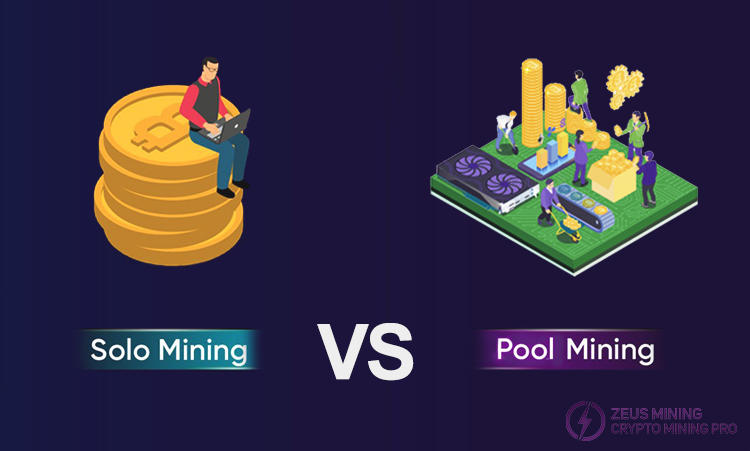
Solo Mining VS Pool Mining: Which is Better?
I. Solo mining
1. Definition and operation mechanism of solo mining:Solo mining refers to miners independently participating in the mining process of the blockchain network without joining any mining pool and competing for block rewards entirely relying on their hash rate. We need to run a complete node, independently verify transactions, package blocks, and try to solve the proof-of-work puzzle. If successful, the miner will receive the full block reward.
2. How to obtain rewards: Use our own solo mining equipment to calculate the block hash value. If we are the first to find a hash value that meets the network difficulty requirements, we can generate a valid block and broadcast it to the network. After being verified by other nodes, the solo miner will receive the complete block reward and transaction fees.
3. Advantages of solo mining:
Substantial revenue: After successfully mining a block, there is no need to share the reward with the mining pool, and we can get 100% of the reward.
Autonomous control: We can have full control over mining equipment, configuration, strategy, etc. We can autonomously optimize mining operations and successfully mine our preferred cryptocurrency.
Privacy and security: Solo miners are independent, reducing dependence on mining pools. There is no need to share data or readings with other miners or mining pools, improving privacy and security.
No pool fees: Mining pools usually charge fees, and solo mining can avoid this part of the cost.

4. Disadvantages of solo mining:
Unstable revenue: Mining results are difficult to predict, and the process depends on luck. Revenue may take months or even years to generate, depending on the network difficulty and the miner's hash rate.
High hardware and electricity costs: High-performance equipment is required, and its continuous operation incurs expensive electricity costs, resulting in a long payback period.
High block solving difficulty: Solo mining has less hash rate, minimizing the chance of discovering a block.
II. Pool mining
1. Definition and operation mechanism of pool mining: It refers to multiple miners combining their hash rate to participate in blockchain mining jointly. Each miner uses their mining equipment to connect to the mining pool server and provides their own hash rate. The mining pool splits the hash calculation tasks and distributes them to each miner for mining. The mining rewards are collectively shared and fairly distributed according to the contribution ratio.
2. How to obtain rewards: Currently, there are three most common revenue models for mining pools:
• PPS: The mining pool pays a fixed income in advance according to the miner's hash rate ratio, regardless of whether a block is mined.
• PPLNS: Distribute the revenue according to the miner's hash rate ratio in the last N contributions, and the settlement is made only when a block is mined.
• PPS+: A hybrid model where miners can not only receive block rewards but also a share of the transaction fees.
3. Advantages of pool mining:
Stable revenue: All miners in the mining pool combine their hash rate to mine a block. This method can increase the probability of mining a block and help miners obtain stable mining rewards.
Easy to start with technology: Mining pools provide software support, simplifying the mining process.
Low threshold: Collective hash rate is used for mining in the mining pool, so novices and beginners can start cryptocurrency mining without investing in powerful ASIC miners.

4. Disadvantages of pool mining:
Pool fees: Mining pools charge a service fee of 1%-3%.
Centralization risk: Once a large mining pool becomes dominant, it may lead to network centralization, and the control of mining strategies and transaction selection will also be restricted.
Dependence on pool operation: Miners may lose their revenue if the mining pool is attacked.
III. Summary of the key comparison items between pool mining and solo mining
Comparison items | Solo mining | Pool mining |
Definition | Miners mine alone and do not share hash rates with others | Multiple miners combine their hash rates and distribute revenue according to their contribution |
Revenue model | Full block reward | Regular distribution according to hash rate contribution |
Revenue stability | Unstable | Relatively stable |
Technical requirements | High, need to run a full node | Low, supported by mining pools |
Degree of decentralization | Fully decentralized | Reliant on mining pools, partially centralized |
Fees | No commission | Usually 1%-3% mining pool fees |
Risks | High risk, high return | Low risk, predictable |
In conclusion, solo mining may bring greater returns but requires many resources and a higher risk tolerance. Pool mining provides more stable revenue but relatively lower individual revenue. The choice between the two depends on various factors, including the miner's hash rate, risk tolerance, and mining goals.
If you want to obtain more stable returns or have limited resources, and are willing to accept lower returns and pay the mining pool service fees, then pool mining may be a more suitable choice. Please carefully consider your situation before making a choice.
FAQ:
Is solo mining more profitable than pool mining?
Independent miners can obtain substantial profits without sharing the revenue with others. The long-term returns of solo mining may be higher than those of pool mining, but it requires patience and takes longer to mine a block.
Can I switch between solo mining and collective mining?
Yes. Some beginners initially choose pool mining to accumulate experience. After accumulating sufficient expertise and experience, they will switch to solo mining.
How to start solo mining of Bitcoin?
We must set up a Bitcoin node and use a solo miner supporting BTC mining. For more details, click How to solo mine Bitcoin? to view.
Disclaimer:
This article is for sharing purposes only. For more details, please refer to other official information. This website will not be responsible for any actions readers take based on the information in this article.
 China Mainland Hong Kong
  Business Hours: (GMT+8) 08:30-20:00 Mon to Sat
  Company Phone: +86-023-72227777